Wellness is not a business its a lifestyle choice

And, why big biz is trying to sell our sick culture on expensive, fixes for very simple problems. lets get into it...
The Biz:
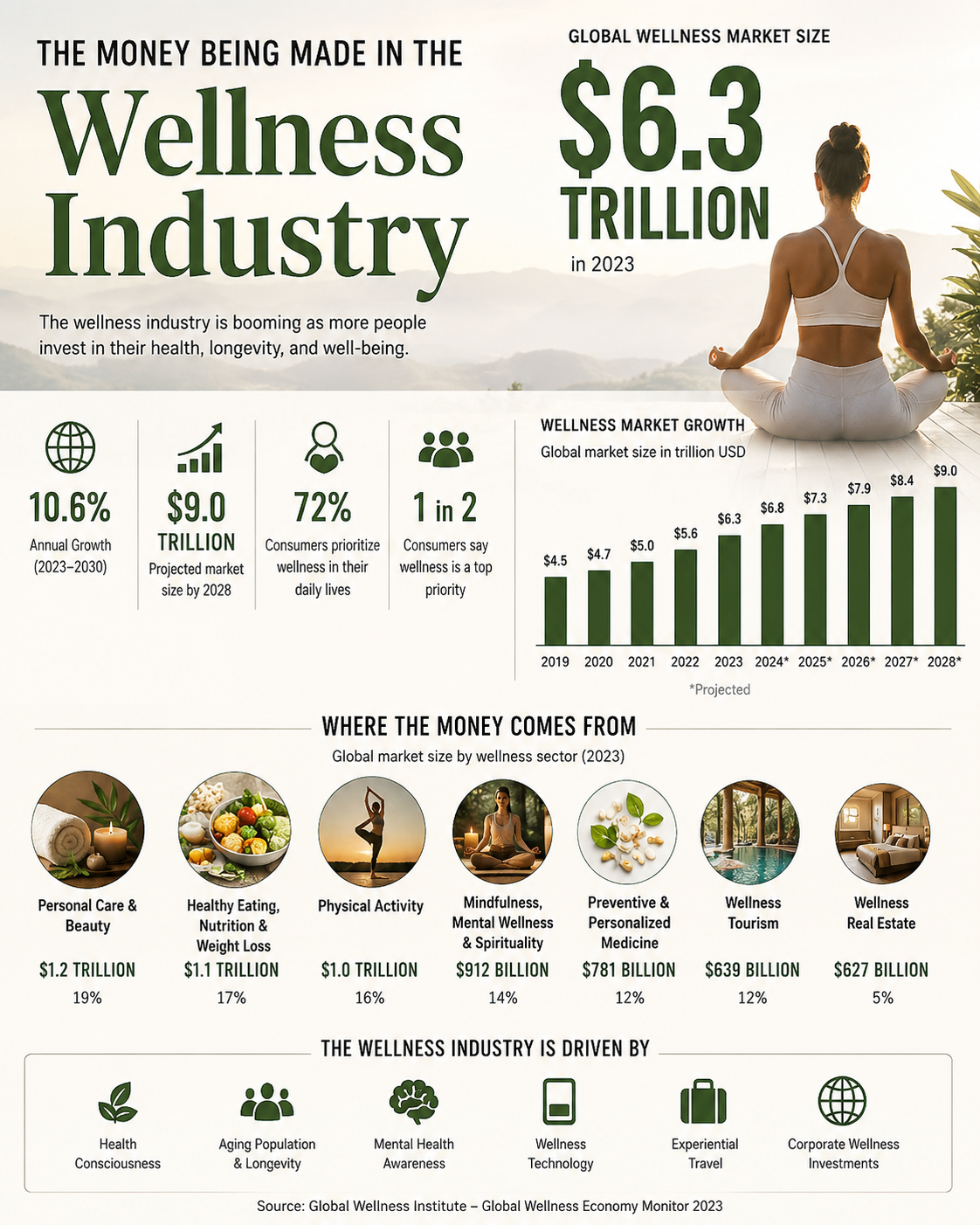
The wellness industry is worth $5.6 trillion. Let that sit for a second.
Five point six trillion dollars built on the premise that you don't know how to take care of yourself. That the accumulated wisdom of every grandmother, farmer, healer, and community elder across ten thousand years of human civilization wasn't enough — that what you actually need is a $47 adaptogen powder, a $200 red light panel, and a biohacking protocol designed by a guy who used to work at Google.
This isn't a health industry. It's a rescue operation that started the fire.
The model is clean: first, participate in the systems that make people sick — processed food, sedentary work culture, digital isolation, agricultural practices that strip the soil of everything that made food worth eating — and then position yourself as the cure. Create the deficiency. Sell the supplement. It's not a conspiracy. It's just capitalism doing what capitalism does when it runs out of new markets: it manufactures need.
And it works, because people *are* sick. Not because they're lazy or stupid. Because the conditions of modern life are genuinely hostile to human biology, and nobody told them the truth about why.
The Hustle
The wellness hustle runs on shame and aspiration in equal measure.
You're not well — but you could be, if you just optimized a little harder. If you tracked your HRV. If you got your cortisol panel done. If you committed to the protocol. The implicit message underneath every wellness brand is the same: *your suffering is a personal failure with a purchasable solution.*
This is sophisticated cruelty dressed up in linen and sans-serif fonts.
The hustle requires you to stay just sick enough to keep buying, and just hopeful enough to keep believing the next product is the one that will finally work. It requires you to see your body as a project to be optimized rather than an animal that knows things. It requires you to distrust the simple in favor of the complex, the cheap in favor of the expensive, the old in favor of the new.
Because simple doesn't scale. Cheap doesn't have a margin. And old wisdom doesn't need a subscription.
The Problems They Actually Make
Here's what the wellness industry doesn't want you to follow to its source:
The anxiety epidemic is downstream of the loneliness epidemic, which is downstream of the community erosion that industrialization required. The metabolic dysfunction crisis is downstream of the processed food system, which is downstream of the agricultural policy decisions made in the 1970s when the U.S. government told farmers to plant corn fence-to-fence and subsidized the seed oils that are now in everything you eat. The sleep crisis is downstream of the blue light environment, which is downstream of the attention economy that profits from keeping you activated past midnight.
None of these have supplement solutions. They have structural causes.
When the wellness industry sells you magnesium glycinate for anxiety, it isn't lying — magnesium probably helps. But it's offering you a patch for a wound that has a cause, and it has a financial interest in you never finding the cause, because the cause isn't purchasable. The cause is: you live in a culture that has systematically dismantled the conditions that make human animals healthy, and rebuilt them as products you can buy back one at a time.
That's the business. That's the hustle. And the problems it creates are subtler than the ones it claims to solve — because now you're sick *and* you're managing your sickness as a consumer identity, which means you're even further from the thing you actually need.

Why This Matters
Because the stakes are not aesthetic.
Metabolic disease is the leading driver of preventable death in the developed world. Loneliness is now classified as a public health crisis with mortality risks comparable to smoking fifteen cigarettes a day. Soil degradation — the actual microbial death of agricultural land — is reducing the nutritional density of food so consistently that a tomato grown today has roughly half the vitamin C of a tomato grown in 1950. These are not wellness trends. These are civilizational emergencies.
And we are addressing them with celery juice.
This matters because a population that is metabolically broken, socially isolated, and cognitively inflamed cannot do the things that need to be done. Cannot build. Cannot organize. Cannot imagine anything beyond the immediate management of its own discomfort. The wellness industry doesn't just profit from sick people — it profits from people who are too tired and too foggy to ask the harder questions. That's not a side effect. For some of the forces shaping this culture, it's a feature.
Let's Get Fatter
I mean that literally, and I want you to sit with your discomfort about it.
The fear of fat — dietary fat, body fat, the word itself — is one of the most successful pieces of manufactured confusion in modern history. The low-fat dietary guidelines introduced in 1980 were not based on strong science. They were shaped by the sugar industry's deliberate campaign to shift blame for heart disease away from sugar and onto fat — a story documented in internal industry documents that didn't become public until 2016. In the years following those guidelines, Americans dutifully reduced their fat intake. They got fatter. They got sicker. Because the food industry replaced fat with sugar and refined carbohydrates, and called it health food.
Full-fat dairy from pastured cows contains conjugated linoleic acid, fat-soluble vitamins, and a fatty acid profile your cell membranes actually use. Egg yolks contain choline, which your brain requires to function. Fatty fish contains the omega-3s that your body cannot produce and that your great-grandmother got from eating the way she ate, before seed oils became the primary fat in the Western diet.
Eat the fat. Not because a wellness influencer told you it's biohacking. Because your body has been eating animal fat for two million years and it knows exactly what to do with it.
And if your body is carrying more weight than the culture tells you is acceptable — the first question worth asking isn't how to lose it. It's what is it actually responding to. Chronic stress. Disrupted sleep. A food environment designed to override satiety signals. A gut microbiome so damaged by antibiotics and processed food that it can no longer regulate appetite the way it was built to. These are not moral failures. They are physiological responses to a broken environment, and shaming them doesn't fix the environment.
Let's Get Slow:
Speed is the wellness industry's best friend.
The faster you move, the less you cook. The less you cook, the more you need to purchase. The more you need to purchase, the more exposure you have to the food system that made you need to purchase in the first place. Velocity is profitable. Slowness is not.
Slow eating is not a trend. It's not mindful eating as a brand. It's the basic physiological reality that your stomach takes twenty minutes to signal fullness to your brain, and if you eat faster than that, you will consistently overshoot without knowing it. It's the reality that chewing is the first stage of digestion and most people have outsourced it. It's the reality that shared meals — sitting with people, without screens, for long enough that the food gets cold and the conversation gets real — do something to human nervous systems that no supplement can replicate.
Slow down not because it's virtuous. Because your biology was built for a pace that the economy has declared unaffordable, and reclaiming it is one of the few genuinely free acts of resistance available to you.
Real Food:
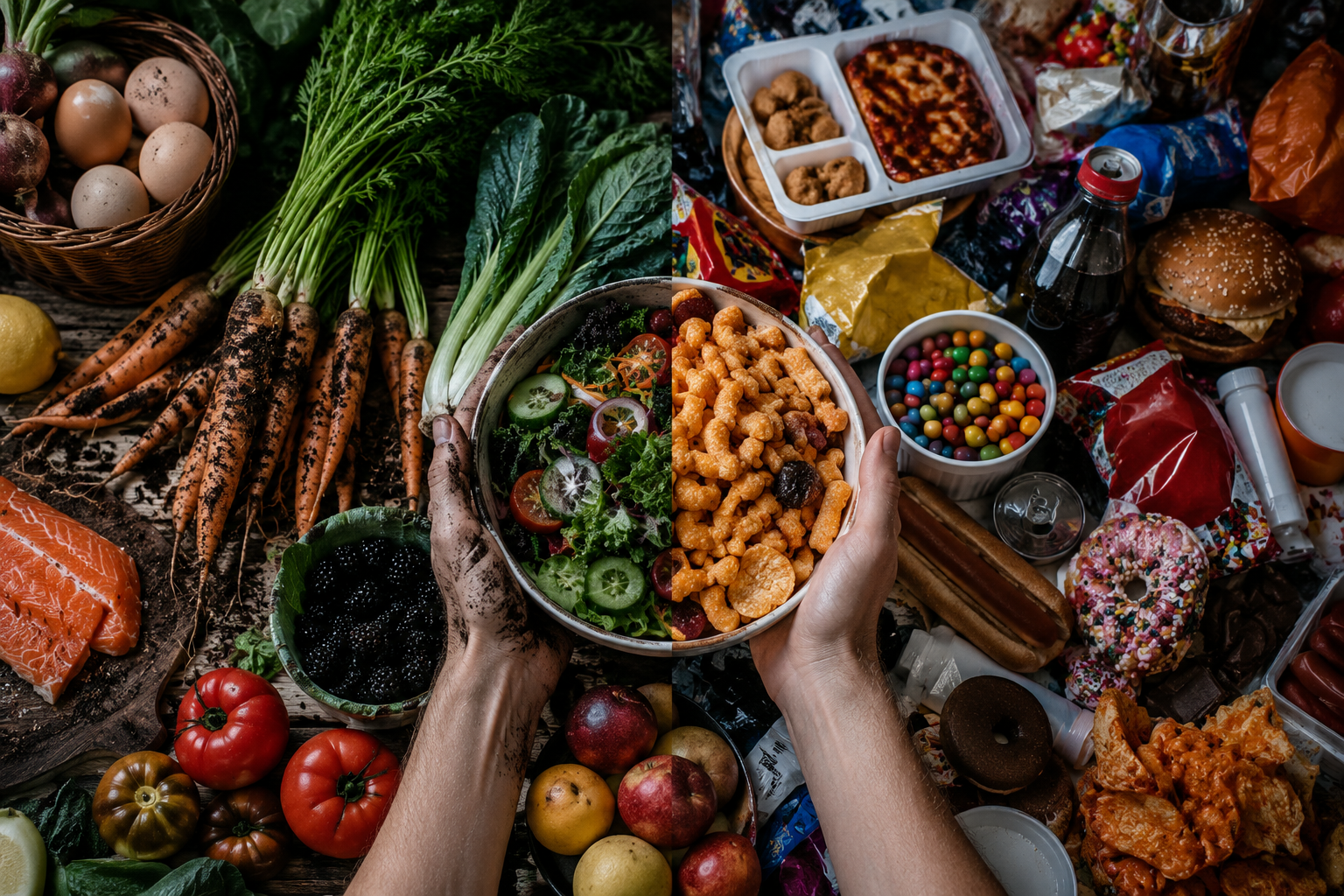
Real food is not a category. It's an absence of a process.
If it was made in a facility, if it has an ingredient list longer than what you'd find in a kitchen, if it was designed by food scientists to hit the bliss point — the precise combination of salt, fat, and sugar calibrated to override your satiety signals — it is not food in any meaningful ancestral sense. It is an edible product engineered for repeat purchase.
Real food has a face or a root. It grew in soil or ate something that grew in soil. It doesn't need a health claim on the packaging because it doesn't have packaging. It goes bad. That's not a flaw — it's evidence that it was alive.
The single most impactful thing most people could do for their health costs nothing and requires no product: eat food that rots. Eat food that your great-grandmother would recognize. Eat food that was grown in proximity to where you live, because locally grown food is harvested closer to